Technical resource 9 min read Updated
Screen Size and Viewing Distance
The reference tables — screen size by audience, how far the front and back rows should sit, throw distance by screen width, how brightness scales with size, and how to compare screens when every supplier measures differently.
Two things set your screen size: how many people are watching and how far back the last row sits. Too small and the back can’t see; too large and you’ve overspent on the screen, the projector, the power and the crew that carries it.
These are the reference tables we use when specifying a system. The practical placement — where the projector, table and speakers go — is in screen, projector and audio setup.
Screen size by audience
Rather see it than read it? The free Audience Layout Planner draws your crowd on the ground for any screen in the range and shows who gets a good view. For cars, use the Drive-In Layout Planner.
| Audience | Suggested screen | Typical setting |
|---|---|---|
| Up to ~50 | 100”–120” framed, or 3 m | Backyards, small groups, school halls |
| ~100–200 | 4 m inflatable | The classic movie-in-the-park size |
| ~200–500 | 5–6 m inflatable | Larger community events |
| ~500–1,000 | 6 m+, or 8 m mattress style | Big public events |
| 1,000–2,000+ | 8–12 m, or LED | Major events; LED if any of it is in daylight |
Where an audience is spread out rather than tightly seated — a park with people on picnic rugs, say — size up rather than down. The people at the edges are further away than your headcount suggests.
Viewing distance
Two rules from cinema design keep everyone comfortable.
The two numbers
Furthest row ≈ 6× the screen height. Closest row ≈ 1–1.5× the screen width.
- A 4 m high image is comfortable out to roughly 24 m.
- A 6 m high image reaches to about 36 m.
Past that, faces get small and any on-screen text becomes unreadable. If your site is deeper than 6× your screen height allows, you don’t need a deeper seating field — you need a bigger screen, or LED, which holds contrast at distance.
At the front, keep the first row back about 1–1.5× the screen width so nobody watches the film with their head tilted back. On a 4 m wide screen that’s 4–6 m, which conveniently gives you a walkway or barrier line.
Throw distance by screen width
Front projection needs clear depth in front of the screen roughly equal to the projector’s throw ratio × the screen surface width.
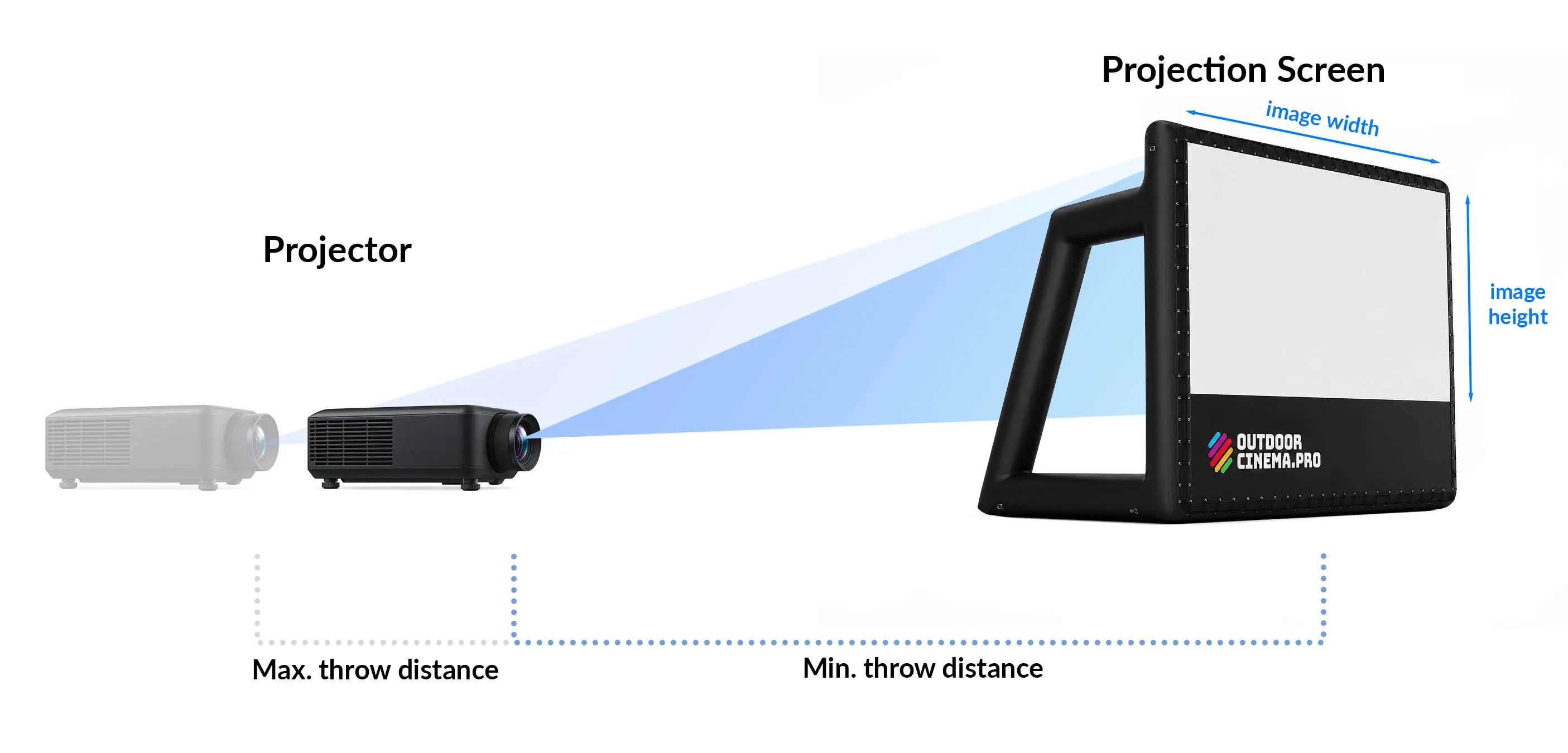
With a standard 1.2–1.5:1 lens:
| Screen surface width | Throw distance (1.2–1.5:1) | Short throw (~0.5:1) |
|---|---|---|
| 3 m | ~3.6–4.5 m | ~1.5 m |
| 4 m | ~4.8–6.0 m | ~2.0 m |
| 5 m | ~6.0–7.5 m | ~2.5 m |
| 6 m | ~7.2–9.0 m | ~3.0 m |
| 8 m | ~9.6–12.0 m | ~4.0 m |
Measure to the screen surface, not the frame — on an inflatable that difference can be half a metre. Keep the projector behind the back row, or on a tower, so nobody walks through the beam.
Our Pro packages
The inflatable Pro packages ship with an Optoma EH412 (throw ratio 1.12–1.47:1), which gives:
| Package | Screen | Projector distance |
|---|---|---|
| 3m Pro | 3 m | 3.36–4.41 m |
| 4m Pro | 4 m | 4.5–5.9 m |
Place the projector anywhere in that band, then zoom to fill the screen.
Short-throw lenses shorten the run dramatically on tight sites, but do not use ultra-short-throw projectors on inflatable screens — the surface is never perfectly flat and the geometry distorts. Shorter throws also magnify any screen movement in wind.
Brightness scales faster than size
Light spreads over area. Double both dimensions of a screen and the brightness landing on it quarters. So lumens have to rise faster than screen width:
| Screen | After dark | Twilight start |
|---|---|---|
| 100–120” framed | 3,000–4,000 lm | 5,000 lm+ |
| 3–4 m | 4,000–6,000 lm | 7,000 lm+ |
| 5–6 m | 7,000–10,000 lm | 10,000 lm+ |
| 8 m+ | 10,000 lm+ | LED territory |
And if any part of the event runs before dark, projection washes out at any size — that’s the point at which LED wins regardless of crowd size.
Comparing screens between suppliers
This is where quotes stop being comparable, and it is worth being pedantic about.
- Overall size vs surface size. Some suppliers quote the whole inflatable including the frame; others quote the usable projection surface. The frame can account for a substantial part of the overall dimension, so a “4 m screen” from one supplier can have a noticeably smaller picture than another’s.
- Width vs diagonal. Large screens are usually quoted as the width of the surface in metres. Smaller screens are often quoted diagonally in inches, like a TV. A 120” screen is about 2.65 m wide, not 3 m.
- Aspect ratio. A 16:9 surface and a 16:10 surface of the same width give different heights, which changes your viewing-distance maths.
Ask for the projection surface dimensions in metres, width × height before you compare prices. Any supplier who won’t give you that number is telling you something.
Venue constraints to check before you commit
- Wind exposure. Open, coastal or elevated sites need proper anchoring, and a very exposed site may favour a rigid fast-fold screen or LED over a tall inflatable that catches wind like a sail.
- Ceiling height if you’re ever indoors — A-frame screens need depth as well as height.
- Access. An 8 m screen in a bag is a two-person lift and needs a vehicle to match.
- Power — bigger screens mean brighter projectors, more audio and more distribution.
- Ground — flat enough for sightlines, soft enough to peg, or hard enough to need ballast.
Not sure? Give us your numbers
Tell us the expected crowd, the venue dimensions and whether any of it runs before dark, and we’ll tell you the size to buy or hire — including when a smaller screen is the right answer.
Common questions
What size outdoor cinema screen do I need?
Size to the crowd first, then check the site fits. Up to about 50 people a 100–120 inch or 3 m screen works; 100–200 people suits a 4 m; 200–500 a 5–6 m; 500–1,000 a 6 m or 8 m; and beyond that 8–12 m or LED. Then confirm the last row is within about 6× the screen height and you have the throw distance in front.
How far back can the last row sit?
About 6× the screen height. A 4 m high image is comfortable out to roughly 24 m, a 6 m image to about 36 m. Past that, faces and any on-screen text become hard to read — the answer is a bigger screen, not a deeper field.
How close is too close to an outdoor movie screen?
Closer than about 1–1.5× the screen width and the front row spends the film craning their necks. On a 4 m wide screen, keep the first row 4–6 m back and use the space for a walkway or a barrier.
Why do suppliers quote screen sizes differently?
Some quote the overall size including the inflatable frame, others the usable projection surface. Some measure across the width, others diagonally. Large screens are usually quoted in metres of surface width, small ones in inches measured diagonally like a TV. Always confirm which figure you are being given before comparing prices.
Does a bigger screen need a brighter projector?
Yes, and more than people expect. Light spreads over area, so doubling both screen dimensions quarters the brightness landing on the surface. A 3 m screen is comfortable on a few thousand lumens after dark; a 6 m or larger screen wants 10,000 lumens or more, especially for a twilight start.
Planning an outdoor screen or LED installation?
Tell us about your site and audience. We scope, supply and support outdoor cinema and permanent LED systems Australia-wide.